When to Send Wedding Invitations in Hawaii: A Timeline Guide
There's one question almost every engaged couple gets wrong about stationery: when to send it.
For a Hawaii wedding, the standard advice you'll find online is usually written for local mainland weddings. The timelines are different here. The guest geography is different. And the amount of planning your guests need to do — flights, hotels, possibly international travel — is a different category entirely.
This is the version that actually applies to Hawaii.
Why Hawaii Wedding Invitation Timing Is Different
A bride getting married in her hometown has a guest list that mostly lives within driving distance. Her guests can RSVP in two weeks and show up on the day of without much planning.
Your guests — whether you're a local Oahu bride with mainland family, or a destination couple flying everyone in from across the world — are doing something harder. They're booking flights. They're blocking hotel rooms. They're requesting time off work, sometimes months in advance.
The sooner you get your stationery into their hands, the more guests you'll actually have on your wedding day.
The Timeline: Local Oahu Weddings
If your guest list is primarily local — Oahu residents, people on the other islands, and a handful of mainland family — use this as your baseline.
Save the Dates
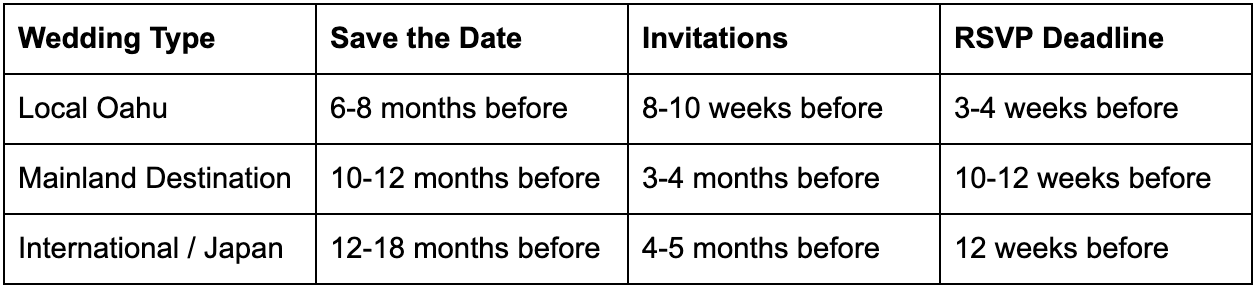
Send: 6 to 8 months before the wedding
Six months is the minimum. Eight months is better. If your wedding falls on a popular date (holiday weekends, spring, December) or at a high-demand venue, go earlier.
Invitations
Send: 8 to 10 weeks before the wedding
This is the standard window for local weddings. Your RSVP deadline should land 3 to 4 weeks before the wedding, which gives you time to finalize the headcount with your venue and caterer.
RSVP Deadline
Set: 3 to 4 weeks before the wedding
The Timeline: Destination Weddings with Mainland Guests
If you're planning a destination wedding in Hawaii with guests flying in from the mainland United States, your timeline shifts significantly.
Save the Dates
Send: 10 to 12 months before the wedding
Mainland guests need to book flights and accommodations, request time off, and potentially coordinate childcare or travel logistics. A year is not too early. If your wedding is during peak Hawaii travel season — December through February, spring break — consider going even earlier.
Invitations
Send: 3 to 4 months before the wedding
This is earlier than most brides expect, but it's the right window. Your guests need time to confirm flights, finalize accommodations, and — importantly — give you a headcount that's actually reliable. A 10 to 12 week RSVP window for destination guests is reasonable and gives you enough lead time to finalize vendors.
RSVP Deadline
Set: 10 to 12 weeks before the wedding
The Timeline: International and Japanese Destination Weddings
Hawaii is one of the most popular international wedding destinations for Japanese couples and Japanese-American families. If your wedding involves guests traveling internationally — particularly from Japan — your stationery timeline needs to account for international logistics.
Save the Dates
Send: 12 to 18 months before the wedding
International guests are often making significant travel decisions. Flights from Japan to Hawaii need to be booked well in advance, especially for cherry blossom season (March-April) when travel demand peaks. The earlier you get a save the date in their hands, the better.
Invitations
Send: 4 to 5 months before the wedding
Allow enough time for international shipping (if you're mailing to Japan), guest response, and your own vendor confirmation deadlines.
For Japanese destination brides, having your invitation suite available in both English and Japanese is a meaningful touch — not just for the couple, but for family members and guests who are more comfortable in Japanese.
RSVP Deadline
Set: 12 weeks before the wedding
The Full Timeline at a Glance
A Few Things That Catch People Off Guard
The RSVP deadline is not the headcount deadline. After your RSVP date passes, you'll spend another 1 to 2 weeks chasing down the people who didn't respond. Build that time into your planning. Your real vendor-facing headcount usually lands about 2 to 3 weeks after your stated RSVP date.
Order more than you think you need. Add 15 to 20 percent to every quantity. Addressing errors, last-minute additions, and keepsakes for the couple mean you will use those extras. Reprinting is expensive and slow.
Hawaii mail timing is real. If you're ordering stationery from a mainland print vendor, packages to Hawaii add 5 to 7 days to standard shipping timelines. A local Oahu print shop removes that variable entirely and keeps things simpler when you need a quick turnaround on day-of pieces.
Don't overlap your save the date and invitation sends. Couples sometimes run behind and end up sending their save the date and invitation within a few weeks of each other. This actually creates confusion — guests wonder if they missed something. Give yourself a clear gap of at least 6 to 8 months between the two.
When in Doubt, Send It Earlier
The most common stationery regret from Hawaii brides isn't "I wish I'd waited longer." It's always the other direction.
If you're not sure whether to send your save the date now or in two more months, send it now. The guests who were always going to say yes will thank you for the lead time. And the guests who were on the fence? More time to make a decision in your favor.
Ready to Get Started?
The Hawaii Wedding Print Shop works with local Oahu brides, mainland destination couples, and international brides planning Hawaii weddings. We handle the design, print coordination, and delivery — with full bilingual English and Japanese service available.
Get a free quote and we'll get back to you within 48 hours with a personalized plan for your stationery suite.
The Hawaii Wedding Print Shop is an Oahu-based wedding stationery studio serving all of Hawaii, with specialized service for Japanese destination weddings and bilingual English/Japanese stationery suites.
Hawaii Destination Wedding Stationery: A Complete Guide
Nobody tells you that destination weddings require a completely different approach to stationery than a local wedding. The timelines are longer. The information your guests need is more complex. And the first piece of paper they receive from you has to do a lot more work — it has to make someone feel confident enough to book a flight to Hawaii.
That's a lot to ask of an invitation. But when it's done right, your stationery suite becomes part of the experience itself.
This guide covers everything you need to know about wedding stationery for a Hawaii destination wedding — what to order, when to send it, and how to make your suite feel like it actually belongs here.
Why Hawaii Destination Wedding Stationery Is Different
For a local wedding, your invitation is really just logistics. For a destination wedding in Hawaii, it's the first moment your guests decide whether or not they're coming.
That changes everything.
Your stationery needs to communicate more information, create more excitement, and give people enough lead time to actually plan their trip. Guests booking flights from the mainland — or from Japan, Canada, or anywhere else — need to arrange travel, accommodations, and time off work. The more organized your stationery suite is, the more confident people feel saying yes.
A generic online invitation template won't cut it here. Hawaii destination wedding stationery should feel like the islands: warm, specific, and considered.
What to Include in Your Hawaii Wedding Stationery Suite
Save the Dates
This is your most important piece, and for Hawaii destination weddings, it goes out earlier than you think.
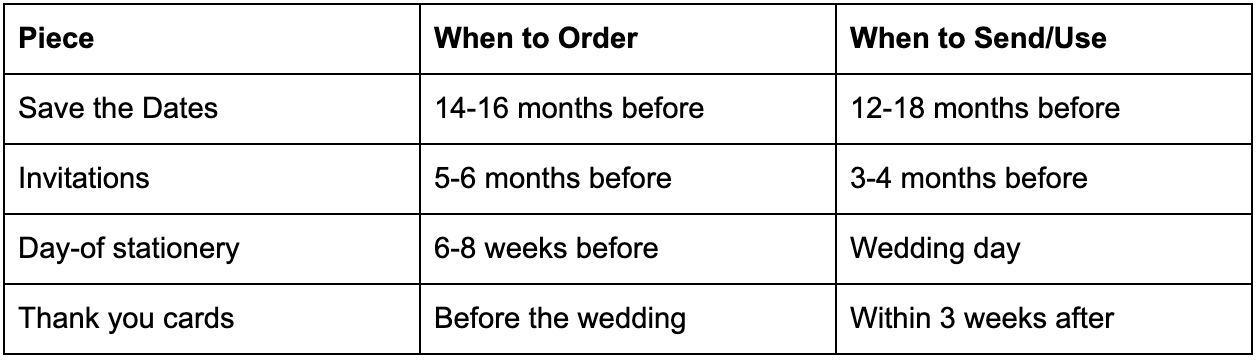
Send save the dates 12 to 18 months before your wedding date. If you're inviting guests from Japan or other international locations, aim for the longer end of that range. People need time to book flights, arrange accommodations, and request time off — especially if your wedding falls around peak travel season (winter holidays and spring break are the busiest times on Oahu).
At minimum, your save the date needs: both names, the wedding date, and the island or city. A wedding website URL where guests can find more details is strongly recommended.
Designs that work especially well for Hawaii save the dates: botanical watercolors featuring plumeria or bird of paradise, clean modern typography with ocean tones, and any design that hints at the landscape without being a cliché. Skip the generic clip art hibiscus.
Wedding Invitations
Your invitation suite is the centerpiece of the whole thing, and it should go out 3 to 4 months before the wedding date. For international guests, lean toward the earlier side.
A full Hawaii destination wedding invitation suite typically includes:
Main invitation card with ceremony date, time, and venue
RSVP card with a response date set 10 to 12 weeks before the wedding (longer than a local wedding — you need headcount to finalize vendors)
Details card with travel info, accommodation recommendations, and your wedding website
Envelope with matching liner or complementary design
One thing that sets Hawaii destination invitation suites apart: the details card. Your guests are planning a trip, not just showing up. A well-designed details card covering where to stay, when to arrive, and what to expect makes an enormous difference in guest confidence and attendance rates.
Day-Of Stationery
Once your guests arrive, your stationery keeps the experience cohesive. Common pieces for Hawaii destination weddings include:
Welcome sign for the venue entrance
Ceremony programs outlining the order of events, wedding party names, and any meaningful readings or songs
Menu cards at reception tables (especially useful for multi-course or catered meals at resort venues)
Place cards or escort cards for assigned seating
Table numbers with a consistent design that matches your suite
Bar signage listing signature cocktails
Welcome bags for guests staying at the hotel — often include a card with a personal note, a schedule of events, and local recommendations
The day-of pieces don't all need to be ordered at the same time as your invitations. Most are finalized 3 to 6 weeks before the wedding once you have confirmed guest counts.
Thank You Cards
Order these before the wedding so they're ready to send within a few weeks of returning home. For destination weddings especially, a handwritten thank you card carries weight — your guests made a real effort to be there.
What Makes Hawaii Wedding Stationery Design Different
The best Hawaii wedding stationery doesn't scream "luau." It reflects the specific version of Hawaii your wedding actually represents — whether that's a luxury resort in Ko Olina, a botanical garden ceremony in Manoa, or a beachfront sunset at Kailua.
Design elements that photograph beautifully and feel authentically Hawaiian without being touristy:
Watercolor botanicals: plumeria, monstera leaves, Bird of Paradise, white ginger
Muted, nature-inspired color palettes: sage, terracotta, warm ivory, soft coral
Hand-drawn maps of Oahu or your specific venue location
Script fonts paired with clean serifs for an editorial feel
Texture-forward paper stocks: linen finish, cotton paper, or matte with soft-touch coating
The best Hawaii wedding suites feel elegant and specific to the place, not like something you'd find in a generic "tropical wedding" template search.
A Note on Bilingual Stationery
If you have guests attending from Japan — or if you are a Japanese couple planning a Hawaii destination wedding — bilingual stationery matters more than you might realize.
Japanese destination weddings in Hawaii are a significant and growing category. Many couples fly in family members and close friends who are more comfortable reading Japanese than English. Having your invitation suite, programs, and key day-of pieces available in both English and Japanese is a small detail that makes a meaningful difference for your guests.
The Hawaii Wedding Print Shop offers full bilingual English and Japanese stationery service — one of the very few stationery providers in Hawaii that does.
Timing Overview for Hawaii Destination Wedding Stationery
Ready to Plan Your Hawaii Wedding Stationery Suite?
You don't have to figure all of this out alone. The Hawaii Wedding Print Shop specializes in stationery suites for Oahu destination weddings — from save the dates through day-of signage, in English, Japanese, or both.
We handle the design, the print coordination, and the delivery so you can focus on the actual wedding.
Get a free quote for your Hawaii wedding stationery
Every couple gets a personalized response within 48 hours.
The Hawaii Wedding Print Shop is Oahu's destination wedding stationery studio, serving local Hawaii brides, mainland destination couples, and Japanese-market brides planning weddings across the island.

Wedding Stationery Checklist for Hawaii Brides: Everything You Actually Need
It All Begins Here
Most brides start the stationery conversation way too late. They've booked the venue, hired the photographer, locked in the caterer — and then realize they haven't thought once about invitations.
Here's the thing: for a Hawaii wedding, whether you're a local Oahu bride or bringing guests in from the mainland or Japan, your stationery timeline is longer than you expect. And the list of what you actually need is both simpler and more specific than what you'll find on most generic checklists.
This is the version built for Hawaii weddings.
The Non-Negotiables
These are the pieces every Hawaii bride needs, no exceptions.
1. Save the Dates
The first official communication from you to your guests. It doesn't need to be elaborate — it just needs to arrive early enough for people to act on it.
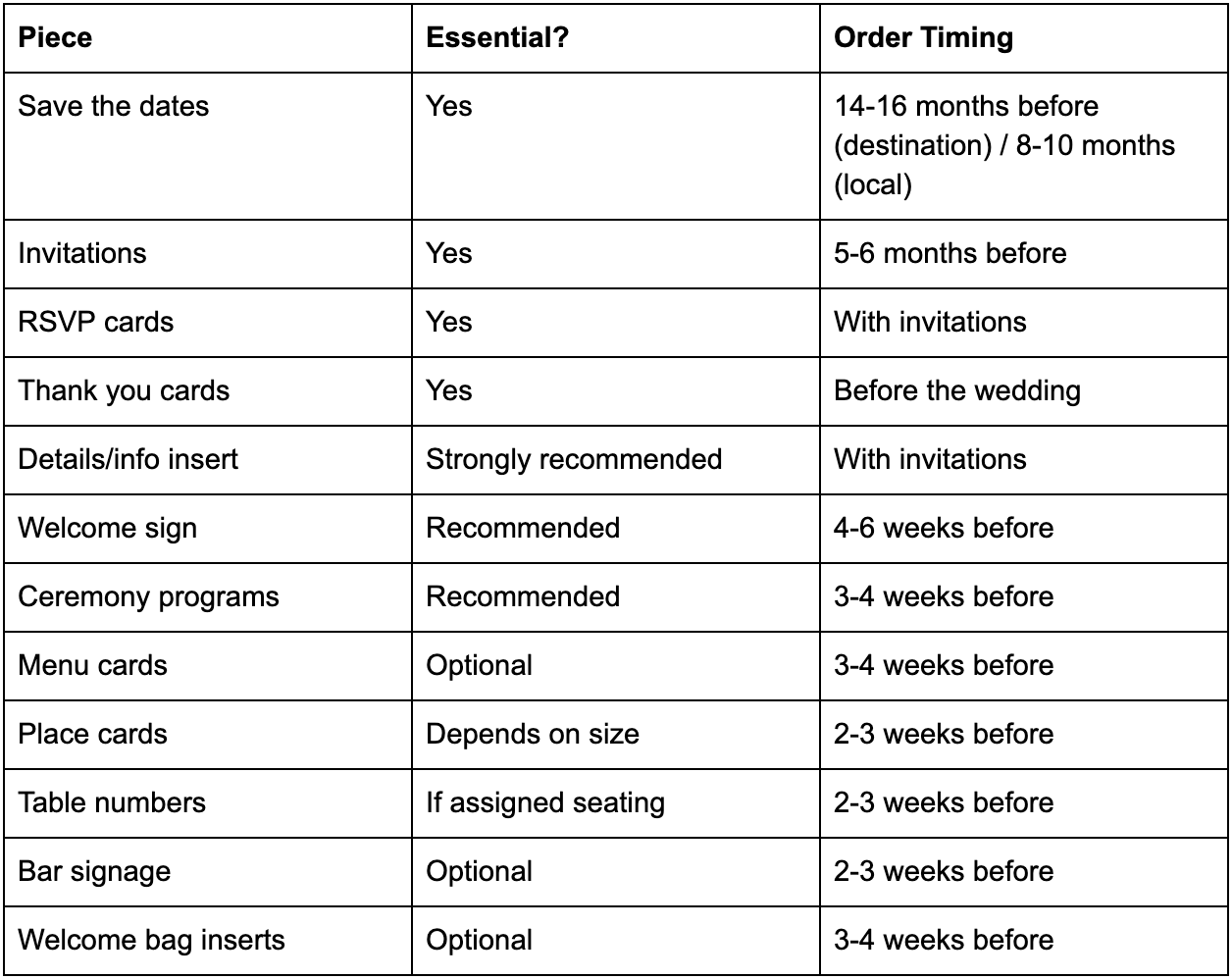
When to send: 6 to 8 months out for local Oahu guests. 12 to 18 months out if you're inviting mainland or international guests.
What to include: Both names, the date, the island (or city), and your wedding website if you have one. That's it. Details come later with the invitation.
How many to order: One per household, not per person. Add 15 to 20 percent buffer for spares, addressing errors, and late additions to your list.
2. Invitations
Your main event. The invitation sets the visual tone for the entire wedding and communicates everything guests need to show up.
When to send: 8 to 10 weeks before the wedding for local guests. 3 to 4 months out for destination guests traveling from the mainland or internationally.
What to include: Names of the couple, ceremony date and time, venue name and address, and RSVP instructions.
One strong rule: Keep the invitation clean. Any additional information — hotel blocks, travel tips, itinerary — goes on a separate insert card, not on the main invite.
3. RSVP Cards
Include these with every invitation. Even if you have a wedding website with online RSVP, include a physical card. Some guests (especially older family members) won't use the website.
RSVP deadline: Set it 4 weeks before the wedding for local events, 10 to 12 weeks out for destination weddings where you need headcount to finalize vendors.
Pro tip: Number the back of each RSVP card in pencil matching your guest list. When cards come back unsigned (it happens more than you'd think), you'll know exactly who sent it.
4. Thank You Cards
Order these before the wedding so they're ready to go when you get back from your honeymoon. For Hawaii destination weddings especially, a handwritten thank you card carries real weight — your guests made an effort.
The Highly Recommended Pieces
Not required, but most Hawaii brides will want these.
Details / Information Card
An insert card that goes inside the invitation envelope alongside your RSVP. This is where you put everything that doesn't belong on the main invite: hotel block information, shuttle timing, parking at the venue, dress code clarification, your wedding website.
For destination weddings, this card is essentially required. Your guests are planning a trip. Give them what they need to say yes with confidence.
Welcome Sign
A sign at the venue entrance greeting guests as they arrive. Simple, elegant, and does a lot of work for a relatively small cost. Especially useful for outdoor Hawaii venues where the entry point isn't always obvious.
Ceremony Programs
More meaningful than most couples expect. Programs give guests context — the order of the ceremony, the names of the wedding party, any readings or songs. They also give guests something to hold and look at during the processional. For formal or religious ceremonies, they're close to required. For casual beach ceremonies, they're a nice touch.
The Optional Extras Worth Considering
Menu Cards
A card at each place setting listing the courses or meal options. Useful if you're having a plated dinner with multiple options, or if you just want the table to look intentional. They also photograph well.
Place Cards and Escort Cards
Place cards go directly at each seat with the guest's name. Escort cards (or a seating chart at the entrance) direct guests to their table. For larger weddings, one or the other is necessary. For intimate ceremonies under 30 people, you can usually skip both.
Table Numbers
If you have assigned tables, you need these. Design them to match your suite for a cohesive look.
Bar Signage
A small sign naming your signature cocktails. Low cost, high visual impact, and guests love knowing what the specialty drinks are. At a Hawaii wedding, naming your cocktails after Oahu beaches or local flowers is always a hit.
Welcome Bag Inserts
If you're giving welcome bags to out-of-town guests at their hotel, include a small printed card with a personal note and a schedule of events for the weekend. This is a premium touch that destination brides often overlook.
What You Can Skip
Every checklist tells you to order everything. Here's what you can realistically leave out depending on your wedding size and format:
Rehearsal dinner invitations: Text or email works fine unless your rehearsal dinner is a formal event
Engagement party invitations: Unless it's a large or formal party, digital invites are completely fine
Belly bands and vellum wraps: Beautiful, but add cost without adding information — save them for the luxury suite tier
Bridesmaid proposal cards: A personal moment, not a printed stationery piece — handwritten notes work better
The Hawaii-Specific Things Nobody Tells You
Allow extra time for delivery. Hawaii is still a 5 to 6 day mail journey from most mainland print facilities. If you're ordering from a vendor on the mainland, factor that into your timeline. A local print shop on Oahu means your pieces are here faster with less risk.
Think about your guest list geography. A Hawaii wedding often has guests coming from multiple places — local Oahu families, mainland relatives, destination couples with international friends. Each group has different lead time needs. When in doubt, use the timeline that serves your farthest-away guests.
Bilingual matters more than you think. If any of your guests are more comfortable in Japanese (or another language), having key pieces — particularly programs and menu cards — in both languages is a genuine hospitality detail. It's not just aesthetic.
Your Hawaii Wedding Stationery Checklist at a Glance
Ready to Build Your Suite?
You don't have to figure out every piece on your own. The Hawaii Wedding Print Shop works with Oahu brides, destination couples, and Japanese-market brides to put together custom stationery suites that fit the actual wedding — not a generic template.
Tell us your guest count, your venue, and your vibe. We'll handle the rest.
Get a free quote — every inquiry gets a personal response within 48 hours.
The Hawaii Wedding Print Shop offers custom wedding stationery on Oahu, including full bilingual English and Japanese service for Japanese destination brides and international couples planning Hawaii weddings.